Reflections on the potential of human power for transportation

Sunday, January 20, 2013

The Prius Electric Bicycle at the Detroit Auto Show


The Detroit International Auto Show has been going on this week and the unanimous star of the show is the new 2014 Corvette Stingray. With 450 horsepower, 450 ft.lb. of torque, a seven-speed manual transmission (starting to sound like derailleur transmissions here) and a 52K$ price tag, the ‘vette excited a lot of sports-car minded attendees and journalists.

While the Corvette launch is typical fare for large auto shows, what is less typical is the presence of vehicles at the other end of the horsepower spectrum, electric bicycles. Both Toyota with its Prius Parlee and Daimler AG with its Smart E-bike displayed models.
 
http://www.triplepundit.com/2013/01/years-detroit-auto-show-concept-car-bikes/

 The Smart bike is shown below.

This is not the first time that vehicles with pedals have show up at large auto shows. In 2011, Ford displayed an E-bike at the Frankfurt Auto Show, but Europe has always taken the bicycle more seriously that the US as a transportation alternative to the car. I like to think that the appearances of these bikes in Detroit is an acknowledgement that human-powered commuter vehicles are playing a more significant role in the transportation matrix


.
Now, while pedalectric bikes offer one form of hybrid human-powered commuter vehicle, they are ill-suited to commuting in inclement weather. An extensive discussion of the characteristics of an ideal HPCV are discussed in “Rx for a Healthy Commute”, below


Now to get displayed at a large auto show, a HPVC needs to be a product of an auto company, like Toyota or Daimler AG. Even though they are developed by non-auto-company enterprises, there  was one vintage and is one new vehicle that deserved and deserve to be displayed to the general car public at a large US auto show.
One HPVC was the Pedicar from 1973, below.


Production of the Pedicar was only 20 vehicles. It didn’t catch on, even though there was a gas crisis going on during its public release. At $550, the cost may have been a deterrent when compared to a bicycle and, even though similar vehicles were used in Europe after WW2, US consumers were just beginning to think of bicycles as commuter vehicles.  If it had an electric assist, which it was ideally suited for, it might have experienced the sales it deserved.
The auto companies did take notice of the Pedicar, however. An industrial designer from Chrysler drew this lampooning cartoon of it.

A modern vehicle which deserves recognition at a large US auto show is the Drymer trike from the Netherlands. With a bit more weather protection, the Drymer would be an ideal all-weather pedalectric commuter vehicle.


So the future is looking up for human-powered commuter vehicles. If the general public begins to consider pedalectric bicycles as viable transportation alternatives, they may be ready to accept and purchase vehicles like the Pedicar and the Drymer.

Hephaestus

Tuesday, January 15, 2013

The Pedal-powered Porsche and the Ultra-Efficient Car

A lot of bicycle technology was incorporated into early automobiles; ball bearings, pneumatic tires, the differential and the list goes on. The efficiency demonstrated by modern human-powered vehicles should be an example for potential improvements in car design. While the two art-piece cars on view below are seen as jokes by the car community, they serve as a departure point to discuss a possible directions for aerodynamic improvements for that most popular commuter vehicle.
I don’t recall how I stumbled on the pedal-powered Porsche. After discovering it I asked the machinist at work, who is a Porsche devotee, about it and he just laughed. It seems it is a big joke among sports-car buffs. The people at Top Gear knew all about it. Driven by Richard Hammond, it holds the record for the slowest lap on their test track.  And there is a follow-on Enzo-Ferrari-like vehicle which appears to be slightly more aerodynamic due to the fact that the Enzo is based on a formula one (F1) car layout. More about the F1 layout later…
Now clearly, both these vehicles, created by Hanes Langder, should be categorized as art pieces. Weighing 100kg and having a huge aerodynamic footprint compared to any enclosed recumbent tricycle; the vehicles cannot be expected to be even as fast as an upright mountain bike. Nevertheless, the human-powered vehicle builder in me is bothered by the laughter associated with the vehicles. Pedal-powered vehicles can be viable transportation alternatives, especially with a small power assist, but the vehicles need to be ultra efficient for 1/3rd of a horsepower (250W) to be able to move the vehicle at anything greater than a walking speed. 
In contrast to the Ferdinand and the Fahrradi, RJK pedalectric velomobile is intended to be a viable commuter vehicle. I have no idea of the weight, but the cross-section of the vehicle appears to be smaller than Herr Langder’s creations, even if the open cockpit incurs more air drag. Of interest is the RJK has front-wheel drive and rear-wheel steering, which may result in a weight reduction from a shortened drivetrain. However, the vehicle’s speed in the video, with one peddler, does not seem to be very fast.
A minimal weight, minimum cross-section, maximum streamlined recumbent bicycle, such as the Varna Tempest, can probably cruise at about 50mph given a 250W input power.
Unfortunately, low visibility, difficult entrance and egress, limited steering etc. prevent such a vehicle from being a practical for commuting. The posts on this blog have spent probably an excessive amount of verbiage discussing how to optimize a vehicle that would use the bike lanes for commuting. See “Rx for a Healthy Commute”, below. But how could the lessons learned from human-powered vehicles make a more efficient car?


These lessons are minimize air drag, minimize weight and minimize rolling resistance. This discussion will primarily focus on efforts to reduce air drag. Weight reduction is assumed to come through use of lightweight materials, space-frame and/or monocoque construction techniques and optimization of load paths that route the payload weights as directly as possible to the wheels. Narrow profile, high-pressure tires would reduce rolling resistance.
Air drag is proportional to the cross-sectional area of the vehicle, the drag coefficient of the vehicle’s shape and the cube of the vehicle’s velocity. The goal in streamlining the vehicle is to reduce the form drag, the product of the area and the drag coefficient. If the form drag gets very low, then skin drag gets significant, and it is beneficial to reduce the total-wetted surface area of the vehicle.
The conventional-rectangular four-wheel layout for cars does not lend itself to being enclosed by classic streamlined shapes.  The difficulty lies with the wheels. Early cars left the wheels exposed and concentrated on enclosing the passenger and engine compartment, the fuselage. Since the top of the wheel is moving a twice the velocity as the vehicle, a rotating wheel has more drag than a static one. When the aerodynamics of the vehicle became more of a concern, the logical approach was to use a streamlined shape (teardrop) for the fuselage and enclose each wheel in a streamlined wheel pant as well. The structure that attached the wheels to the main fuselage also needed to be streamlined, often with wing-like sections. This approach minimizes the vehicle cross-section but results in added interference drag where the various streamlined elements came in contact with each other. The typical result is similar to the 1938 Hispano Suiza Xenia shown below.

Or the contemporary Enzo Ferrari …


This aerodynamic layout, enclosing with the fuselage and wheels separately originated with early motorized carriages. I like to think of it as the F1 layout, even though F1 cars cannot enclose their wheels.
The alternative approach is what most contemporary cars employ, enclosing the entire vehicle in one or more streamlined shapes. The upside is that interference drag can be reduced while the downside is the cross-sectional area of the vehicle is increased and the aero shapes are less conventional and less efficient. If the vehicle area must expand excessively to allow the use of a shape with a low drag coefficient, the resulting vehicle may not benefit from an overall reduction in form drag. The Schlorwagen, below, has a low drag coefficient of .15 and looks very streamlined from the side view.


 But in the front view, the cross-sectional area of the vehicle appears to be rather large.


The track (transverse wheel spacing) for the rectangular-wheel layout is determined by the width of the fuselage and the roll-over resistance of the vehicle when cornering. If the passenger compartment can be kept narrow, for example if the seating is reduced to two people in tandem, and the vehicle is allowed to lean like a motorcycle, that the cross-sectional area can be additionally minimized. See “The Drymer and Varna Lean Forward” below.
Going to a three-wheel layout can bury one of the wheels in the fuselage and thereby improve the drag coefficient, especially if the steered wheel is buried. The downside of this approach is that, for a given rollover resistance, a three-wheel vehicle must be approximately 50% wider track than a four-wheel vehicle. This adversely increases the cross-sectional area.
For simplicity, this discussion will concern itself with the more-conventional four-wheel rectangular layout. 
The design team at Edison2, who won the Progressive Automotive X-Prize for a four-wheel, four seat vehicle that bettered 100mpg, have been refining the F1 layout with the second iteration of their Very Light Car.


Interestingly, the top view of the Very-Light Car Mk2 looks a lot like a modern version of the Hispano Suiza above albeit with a much greater degree of fender seperation and more streamlining. Edison2 is probably at the leading edge for efficient vehicle design, both in aerodynamics and lightweight vehicle construction.


One means of reducing the air drag even more than the Very-Light Car is to narrow the passenger compartment by going to two-passenger tandem seating, similar to the Messerschmitt car from the 1950’s.

 It is of interest that the earlier Messerschmitts were three-wheeled with the single-driven wheel in the back. This is a later version which employed a larger engine. The rear seat of the Messerschmitt could hold a second person or haul cargo. An interesting design feature (shared by my friend Jerry Onifer) was that the center of gravity, c.g., of the vehicle was located in the rear-seat compartment. The idea was that the vehicle’s dynamic performance would remain independent of the load that was being carried in the rear seat.
So the vehicle I envision is similar to the So-Cal Bonneville streamliner in the photo at the beginning of the article. I would use narrower tires enclosed in wheel pants and the structure connecting the wheels to the fuselage would fit within horizontal wing shaped enclosures. Assume a vehicle height of 40” (that of a low sports car). If the c.g.is lower than 20”, for a one-gee rollover resistance the track could be 40”. This is less than ½ the track of a typical car. There could be some additional benefits to having such a narrow vehicle, since it takes up less width on the road.
Once you have a design for a vehicle that is aerodynamically efficient and light weight any source of motive power will benefit from the vehicle’s efficiency. I do not believe that electric propulsion is the magic bullet that solves fossil-fuel consumption problems. If the vehicle design allows for an extended driving range with batteries, the vehicle will get exceptional gas mileage with an internal-combustion engine as well.
The above being said, I envision the tandem ultra-efficient car being propelled by a hybrid power plant. The power source would be a small gas turbine driving an electric generator. The electricity from the generator would, in turn power an electric motor located in each of the four wheels. There would be onboard batteries to provide for increased power for acceleration and regenerative braking. There will be a weight penalty for using four motors instead of using one motor with four times the power. Having a motor in each wheel also violates the suspension principle of minimizing unsprung weight. On the other hand, having motors in each wheel that can be controlled independently eliminates three mechanical differentials as allows for unprecedented traction optimization under microprocessor control. Volvo used a turbo-generator and wheel motors in a concept car during the 1990s and Jaguar used twin turbo-generators more recently.

The X-Prize-winning Very Light Car weighed 830lb., was powered by a 30kW IC engine and had a drag coefficient of .16. Could a tandem two-seat version maintain the same drag coefficient, significantly reduce the cross-sectional area, weigh less than 200lb and be powered by a 7.5kW turbo generator? And would a pair of pedals get you to a gas station if you ran out of fuel?

Hephaestus  


Friday, November 23, 2012

The Return of the Recumbent Bicycle

Last September, after allowing it to gather dust in the garage for the last six years, I started riding my Avatar 2000 recumbent on the road again. I had forgotten how much fun it was to cruise down the road sitting with a car-like posture and taking in the scenery instead of being hunched over the handlebars with only a narrow view of the road ahead. I also had forgotten how awkward hill climbing was; dropping into the granny ring and spinning as if my life depended in it. Yes, my relationship with my recumbents was a love and hate thing.
My relationship with recumbent bicycles began three years after I purchased my first derailleur bicycle, a gas-pipe-framed Schwinn 10 speed. I bought the April 1969 issue of Popular Mechanics because it had an article by the do-it-yourselfer extraordinaire, Robert Q. Riley. The article was about the construction of a low-slung bicycle he called the “Ground Hugger”. I had never seen anything like it and started thinking about how I could build one.

 
As the article said “You’re cradled in a bucket seat and as you lean into a long-banking turn, you have the exhilarating sensation of being on a toboggan with wheels”. To a cyclist, this was an exciting prospect.


Many in the non-cycling community believe that Riley invented the recumbent bicycle. Instead Riley had copied the essential elements of a bicycle designed and built by the ex-airline pilot and bicycle innovator Captain Dan Henry.
Henry, famous for the Dan Henry markers used to guide cyclists on organized rides, wrote an article for the May 1968 issue of Bicycle Magazine describing his recumbent. He designed it based on what he felt were the best characteristics of pre-WW2 recumbent bicycles.


While Riley never admitted copying Henry’s recumbent, the similarities between the designs are numerous, especially the long wheelbase and remote steering. While Henry used a chain and sprocket for the fork-steering connection, Riley used a Cardan universal joint from a socket set. Why neither of them used the much simpler connecting rod between an offset pivot on the handlebars and one on the fork, I do not know. One interesting consequence of the use of a u-joint is the coupling ratio varies with the position of the joint. This could be used to improve steering control by having the steering be least sensitive when the steering is straight and becoming more sensitive with increasing steering lock. (Riley may have seen that the preWW2 Velocar used a Cardan joint to connect the handlebars to the fork.)
(A note here that chopper-style kid’s bicycles like the Schwinn Stingray are technically semi-recumbent bicycles and, for that matter, the children’s Big Wheel tricycle and its variants are recumbents. Here I am only interested in the reemergence of the adult recumbent bicycle.)
Henry was not the first to experiment with recumbent bicycles since WW2. Gunnar Fehlau, in his book “The Recumbent Bicycle”, describes the obscure work of the engineer Paul Rinkowski on short-wheelbase recumbents starting in the late 1940’s and continuing on for four decades.
And then there is this fascinating picture of two riders on very-low Grubb-style recumbents in Popular Mechanics from March of 1952. Notice, in this case, that the remote steering uses cables to connect the under-seat handlebars to the forks.


In addition, Alex Moulton of small-wheeled-bicycle fame experimented with a Grubb recumbent prior to settling on an upright posture for his improved-bicycle design in 1962. Moulton found that recumbent pedaling produced thigh fatigue when pedaled for extended periods and rejected the recumbent approach. It was a lost opportunity for recumbent evolution, given Moulton’s innovative product improvement abilities.   
Henry’s recumbent bicycle may have influenced the east-coast arm of the subsequent human-powered vehicle movement, Prof. David Gordon Wilson of MIT. He must have been aware of Henry’s article, because he wrote an article, “Where Are We Going in Bicycle Design?” published in Bicycling the previous month. He also included a photo of Henry’s recumbent in Bicycling Science, the book he coauthored with Frank Roland Whitt in 1974.
From 1967-1968 Wilson sponsored a design competition for man-powered land transportation. The winner, W.D. Lydiard, designed and actually built an enclosed mid-wheelbase recumbent bicycle. Traditionally recumbent bicycles either had the cranks behind (long wheelbase) or ahead of the front wheel (short wheelbase). Those with a long wheelbase were inconvenient to transport and had a lightly loaded front wheel that could wash out on slippery surfaces. The short wheelbase designs had an overloaded front wheel that consequently resulted limited-front-tire life and in skittish handling. If the cranks are located in the ideal location, above the front wheel, the bottom-bracket height was usually so high that the rider is placed in an uncomfortable posture. I refer to the issues with these approaches as “the recumbent packaging problem”. Refer to “Recumbents and Convergent Evolution”, below.
     

To reduce the pedal height, yet maintain their location over the front wheel, Lydiard used a squashed pedal path generated by a crank-slider-type mechanism. Lydiard felt that this approach could be refined to eliminate the problem of interference between the feet and pedals when putting the feet on the ground.


Wilson was apparently quite captivated by Lydiard’s mid-wheelbase, squashed-pedal-path approach. In a private communication, Wilson shared 17 permutations on this design approach, the latest being dated 1977. To my knowledge, none were actually constructed. Based on one of Wilson’s drawings, I built up a crank-rocker or treadle mechanism for my EcoVia 2.2, but power-production limitations caused me to abandon the design. See “Transcending the Pedicar, Part 2”, below.
In 1972, while Wilson was designing linear-drive recumbents, H. Fredrick Willkie, being inspired by Wilson’s design completion, contacted him for a sketch for the design of an advanced bicycle. Interestingly, the recumbent that resulted from that sketch didn’t utilize a linear drive. Ultimately there were five iterations in this design exercise, culminating in the Avatar 2000. Willkie did two designs which he christened “Green Planet Specials”. The first version had handlebars in front of the rider’s chest connected directly to the fork and a high bottom bracket. The design was very similar to the preWW2 Rivat recumbent. Willkie found the compressed body posture uncomfortable and at Wilson’s suggestion, the second version had a lowered bottom bracket and a more leaned-back seat angle. In addition it had direct steering with the handlebars mounted beneath the seat. Wilson bought the GPSII from Willkie and continued to modify the design as the Wilson-Willkie. The seat back was made more vertical and the weight on the front wheel was reduced from about 70% to about 65%. The Avatar 1000 followed and the front-wheel loading was reduced to about 62%. Finally, with the Avatar 2000, the radical step was taken to move the front tire ahead of the bottom bracket, and the front wheel loading dropped to about 31%. Under Wilson’s guidance, two Boston-area bicycle builders, Richard Forrestal and Harald Maciejewski began manufacturing the Avatar 2000 in 1979, making it the first production recumbent since WW2. (A more comprehensive description of the evolution of the Avatar recumbent, including photos of the five vehicles above, can be found in Wilson’s article, “Evolution of Recumbent Bicycles and the Design of the Avatar Bluebell” in the proceedings of the Second International Human Powered Vehicle Scientific Symposium.    

The Avatar 2000 recumbent was very similar to the preWW2 British Grubb recumbent. Both use indirect steering with the handlebars coupled to the fork by a connecting rod. Differences were the Avatar’s seat was higher and more upright and the Avatar had a shorter wheelbase due to the use of a 16” front wheel.  The Avatar’s wheelbase is 63”.
So there is a circuitous linkage between the Ground Hugger and the Avatar 2000.
In 1984, after becoming somewhat bored with upright bicycles, I purchased an Avatar 2000 from Angle Lake Cycle in Seattle. It was serial number 085 and it had been sitting in the store window for several years.
I was disappointed with both the on-the-level speed and, even more so, the hill-climbing speed of the Avatar. On the positive side, the extreme comfort riding the Avatar on the level terrain somewhat compensated for the reduced speed by eliminating fatigue from secondary effects like a sore seat, sore back and numb hands.
I did make one component change that significantly improved its hill-climbing ability. I replaced the conventional cranks with a Power-Cam crankset which I had purchased several years before.

The Power Cam was invented by Dr. Lawrence Brown of IPD (International Patent Development). The design involved chainrings that could float relative to the cranks. A cam follower attached to the cranks rode on a cam attached to the bottom bracket and drove the chainrings through a gear sector. The inertia of the bicycle kept the chainrings rotating at a near constant speed and the cam mechanism caused the cranks to speed up and slow down relative to the chainrings as a function of pedal position. The net result was the mechanical power pulses during pedaling became shorter and larger than with a conventional crankset using round chainrings. As a consequence, the rest periods between the pulses (two per cycle) became longer. The longer rest periods are physiologically more efficient and, for a given oxygen consumption, the aerobic power output was increased. (More on factors influencing power production in a future post.)
Using a Power Cam on a recumbent was suggested by Edward P. Stevenson in his book “The High-tech Bicycle”. The Power Cam did not work well when standing up on the pedals and forced you to climb seated. On a recumbent you couldn’t stand on the pedals so a Power Cam on a recumbent made a kind of sense. Stevenson was correct and it improved hill climbing. The Power Cam had only two chainrings, however, so an adaptor plate was machined to allow the mounting of a third granny chainring.
The increased comfort of the recumbent posture allowed me to take longer rides than on my upright and I logged a lot of miles over the 22 year period between 1984 and 2006. I eventually added an arm-power attachment to the Avatar to scavenge some of the power I was loosing through the inefficiencies of my leg pedaling. See “Arm Power and the Avatar Recumbent” below.
In 2006 I started mountain biking regularly and put the Avatar in moth balls. I began with a hardtail and later purchased a full suspension bike. My hardtail acquired road tires and became my road bike. I didn’t ride on the road much, however, because of numb hands and tired back from sitting in one position for extended periods. I didn’t have this problem when riding on dirt because of a continuingly changing body position and the reduction of road vibration due to the full suspension. The level of comfort riding an upright bicycle off-road was acceptable.
It was on a car trip up to Snoqualmie Fall for breakfast on Labor Day that I was reminded of the number of time I had ridden the scenic hill climb up to the falls on the Avatar. I have never done that ride on my converted mountain bike because of the associated lack of comfort. Realizing what I had been missing the last six years, I decided I would ride the recumbent on the road and the upright on dirt, thus having the best of both worlds.
The first few miles back on the Avatar after the six year hiatus were a bit shaky and the long hill climb back home was a painful grind. But when riding on the flats what I was left with was the feeling of being in a touring car where I could comfortably view the scenery while exercising at the same time. For me, the recumbent bicycle has returned.
Hephaestus  


Saturday, September 29, 2012

Transcending the Pedicar: The EcoVia, Part 2

Human Powered Commuter Vehicle Criteria

1.       Weather Protection
2.       Statically Stable
3.       Reasonable Cruise Speed
4.       Cargo Carrying Capacity
5.       No Wider than a Bicycle
6.       Same Height as an Auto
7.       Comfortable posture and ease of entry
8.       Two-wheel drive
9.       Car-type Wheels
10.   Electric Assist for Hills


The EcoVia 2.1 was well on the way to becoming a vehicle that satisfied the HPCV criteria. Unfortunately I did not feel it satisfied #7. I did not consider the riding posture as comfortable as it needed to be. The bottom bracket was higher than the seat and it needed to be below the seat, at least four inches below if possible.
EcoVia 2.2
I had fallen victim to “the recumbent design problem” where the pedals wanted to be where the front wheel was. (Refer to “Recumbents and Convergent Evolution” below.)
For reasons of leaning functionality the wheel layout was fixed at one front and two rear wheels, with the front wheel steering. I wanted a compact package, so having the cranks behind the front wheel was rejected. So too was putting the cranks before the front wheel because of the skittish handling that came along with that location.
My first thought was to squash the pedal path, thus lowering the upper position of the pedal without causing interference with the wheel in the lower position. In his article “The Development of Modern Recumbent Bicycles”, Dave Wilson presents three sketches of mechanisms that produce elongated pedal paths.
 The simplest of these is known as a crank-rocker (actually crank, connecting rod and rocker) mechanism in kinematics and historically as a treadle mechanism. It can be made very rigid, since there is only one link between the pedals and the frame. It also has a fixed range of motion with built in decelerations and accelerations at the ends of the stroke. The literature seems to suggest that this type of reciprocating motion produces more power than levers pulling chains over one-way clutches. Recall the latter approach was used in the Pedicar. (Refer to “Pedicar Technology”, below.)

After rotary cranks, the treadle drive may be the most often used method of converting leg motion into rotary motion.  It predates cranks being used to propel velocipedes. It was used in the first attempts to build a safety bicycle and it is used in most children’s pedal cars. My favorite period picture of a treadle driven bicycle is Oscar Egg’s recumbent form the 1930’s. Egg had set the hour record several times on a conventional bicycle and he competed with Francois Faure in recumbent record attempts.


My implantation of the treadle mechanism for the EV2.2 was a bit different from previous embodiments. I fabricated a pedal that would allow connections to both sides of the pedal’s axle. The second connection was formed by brazing a bolt to the pedal’s steel dustcap. The pedal mounting was reversed with the normal thread being mounted outboard of the pedal. The rocker link was connected to this thread. The other end of the rocker was supported by a pair of Igus bushings, which, in turn, were held by a tube that was brazed to a rectangular frame that surrounded the front wheel. This frame did dual duty, since it also contained the pivots that would hold the front tilting faring. As result of the outboard location of the rocker links, they did not interfere with the front-wheel's ability to turn. The other, inboard end of the pedal was attached to a bent connecting rod whose other end was attached to a conventional crankset with the arms shortened. The connecting rod was bent to clear the top of the tire. The entire mechanism was very compact and it positioned the rider’s feet in a low and very comfortable position.
As successful as the packaging turned out to be, the performance was anything but. You see, I had overlooked one critical fact. Almost all the historical uses of treadle drives were on bicycles with fixed gears. The motion of the vehicle carried the pedals over the dead spots at the ends of travel. Problems with the dead spots became painfully obvious when attempting to climb even the most gradual of hills. As a bicycle moves progressively slower when the rider climbs increasing grades, the rider must apply the propulsive torque over a greater portion of the pedal stroke. (An explanation of this will come in a future post on why bicycles climb steep hills so poorly.) With the treadle mechanism, the rider can only apply a torque through the middle of the stroke. Pedal forces required to produce torque near the end of stroke become enormous and forward motion is lost.
I had an old Bullseye elliptical sprocket with a 1.56:1 ratio. I thought I could use it to modify the sinusoidal pedal velocity to improve hill climbing. Mounted in one orientation it would slow the pedals in the middle of the stroke and speed them up near the end.  This is the orientation I expected to improve performance but to no avail. Rotating the elliptical sprocket 90deg also showed no improvement, and I concluded that the round sprocket gave the best performance, which was still woefully inadequate. Oddly enough, however, the cable-clutch system used on the Pedicar, while lacking in power output due to limited pedaling cadence, did work well on steep hills because the output torque was constant except at the extreme ends of pedal travel.  While this approach would have solved the hill climbing problem, its limited power output would have restricted the speed of the vehicle. So much for unconventional drives…

EcoVia 2.3
I realized that if the bottom bracket was almost touching the tire, I could drop the bottom bracket height from 26” to 20”. If I kept the bottom bracket close to the steering axis and spaced the crank arm as far apart as I could, I might have enough front wheel lock to have a viable solution. I bought the widest triple-crank bottom-bracket axle I could find. I coupled this crank to an intermediate crank (left over from the treadle drive) on the left side and tensioned that chain with a spring-loaded chain tensioner. The right side of the intermediate-crank carried triple chainrings.
The acid test was riding the two miles to the library. The overlapped-crank drive passed with flying colors, the only crank/tire interference occurring during very tight, slow turns.
 In addition to lowering the bottom bracket, I changed the lower mounting position of the shock to raise the seat and I moved the seat back forward by adding an extra bend near the top. The result, while not being as ideal as the Avatar 2000, was a great improvement, enough to make the EV2.3 comfortable to ride.
All of the EcoVias used caliper brakes on all three wheels. Per tradition, the left lever actuates the front brake. The right lever actuates both rear brakes through a linkage that balances the forces applied to each rear brake. The travel of the right lever was increased to produce the greater cable motion required to actuate two brakes.
The middle cable from the brake lever is attached to a toggle linkage. The ends of the toggle linkage are attached to brake links that pull cables attached to the individual brakes. As the toggle flattens out, the forces on the brake links increase. If one caliper clamps the rim first, its brake link stops moving and the toggle motion continues to move the other brake link until its caliper clamps the rim. This balancing mechanism would be unnecessary if hydraulic disk brakes were used. Unfortunately there is no room for the disk rotor on the cantilevered hubs.
Now, actuation of the rear brakes had an unexpected consequence.  During leaning, each wheel rotates slightly with respect to its wheel beam. Since braking prevents this rotation, the act of braking the rear wheels inhibits leaning.  So during an emergency braking maneuver, when leaning is undesirable, it is automatically prevented. 


Below is a picture of the suspension-shock attachment locations, the wheel-beam-reverser linkage and the disk brake sector used as the lean-lock mechanism. The vehicle is in its upright position.


Below are two pictures of the vehicle leaned over.


Below is a detail of the seat. The lever on the rider’s left engages the motor. The lever on the rider’s right engages the lean lock.
Electric Hill Assist
The electric hill assist uses a geared Astroflight cobalt motor that drives one of the rear tires through a 2”dia. aluminum puck. The puck is brought into contact with the tire by pulling upon the motor engagement lever, above. The gear ratio of the motor is 2.7:1. At 24v, the motor can put out 675W at 3430rpm at the motor rotor. The results in a vehicle speed of 7.6mph for a vehicle payload of 300# climbing a 15% grade. The speed should top out about 15mph on flat terrain. The batteries and motor controller are not incorporated at this point.


Faring
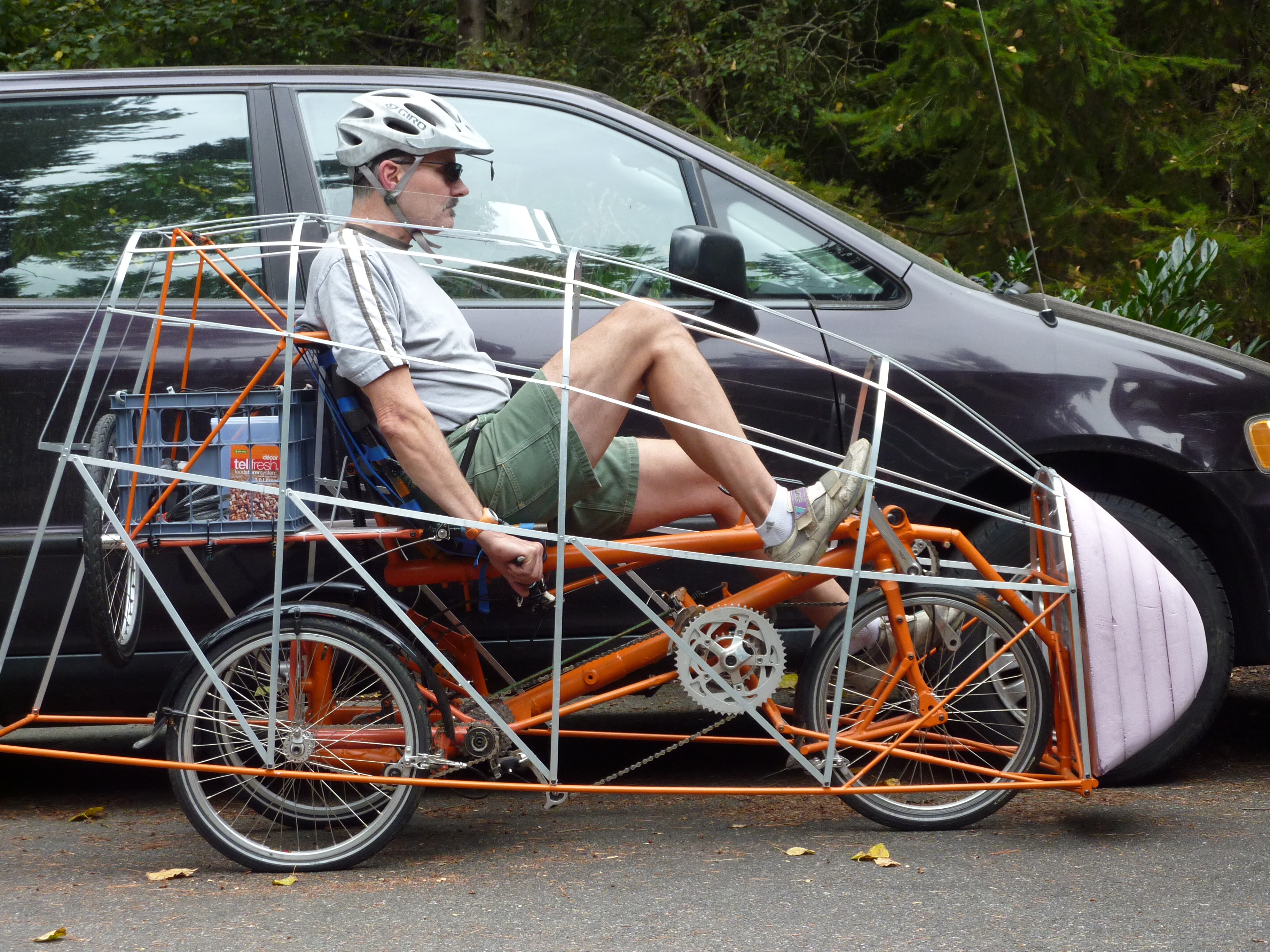
The faring frame is made up of a ½”dia. tubular steel loop and ½ x1/8”aluminum strips bolted to the loop and pop riveted to each other. ¼ x 1/8 ” aluminum strips are pop riveted to the wider strips. A polycarb windscreen is pop riveted to the ½” strips and a foam nosecone made up of laminated insulating foam is bolted to the front of the loop. At this point the faring frame remains uncovered. I am soliciting suggestions for a heat-shrinkable material to cover the frame. 


 The faring tips forward to allow for the rider to get into the vehicle.

The rider sits at about the same height as the driver of a typical minivan.

When the faring frame is covered, the total weight of the EcoVia will be about 100#. 60# is for the tricycle proper, 20# is for the motor and batteries and 20# is for the faring and mounting framework.
I consider the EcoVia 2.3 a proof-of-concept vehicle. All the features that comprise the design work, but features were added piecewise instead of being integrated as in a production vehicle, or even a prototype. So, before discussing how the EcoVia transcends the Pedicar, I would like to paint a word picture of what a productized version of the EcoVia would be like.
·         11-36 tooth, 10-speed cassettes are readily available. (The EV2.3 uses a 12-32 tooth, eight speed cassette.) Attaching one of these to the central driveshaft and using a single chainring would make an intermediate bottom bracket and secondary crankset unnecessary for flat terrain and would greatly simplify the drivetrain. For hills, the motor drive would provide the extra climbing ability. (Sram now makes a 10-42t, 11 cog cassette, but at a cost of almost eight times the 11-36 model, it is not a cost-effective alternative.)  Instead of using bar-end-shift levers at the ends of the handlebars, a twist grip or a trigger shifter could be used. Elimination of the bar ends would allow the width of the faring to be decreased at least by three inches.
·         Recall that the frame is made up of two pieces. The upper frame is a seat tube which is supported by a pivot at the fork end and a shock absorber at the rear. The lower frame is a 2”dia. tube that supports the fork, pedals, driveshaft, wheel beams and banking linkage. Much of the lower frame was carried over from the rear-steering EV1. If the lower frame is redesigned, it can be made significantly lighter. The weight of the rider is supported by the seat-tube pivot in front and the shock in the rear. The seat pivot loads go almost directly into the front tire through the fork. The shock loads go almost directly to the rear wheels through the wheel-beam-reverser linkage. So the lower frame does not carry these loads. The lower frame holds the head tube stationary, reacts the chain forces between the cranks and the driveshaft and fixes the lower shock mount and the reverser –pivot with respect to the drive-shaft tube. These loads are small enough that a space frame made up of thin-wall ½”dia. tubing can be substituted for the 2”dia. tube in the current version. This should significantly reduce the weight, since three, ½”dia-.028wall steel tubes weigh .45#/ft, while one, 2”dia-.065 wall tube weighs 1.4#/ft. The seat  tube could be dipped in the middle to aid in step over when getting onto vehicle.
Refer to the sketch below.


The second major change to the lower frame is to support the wheel beams directly on the drive shaft using ball bearings instead of using an intermediate tube and bushings. The over all goal is to try and reduce the weight of the tricycle proper to about 50#.

·         Currently the motor drives only one rear wheel through a puck. To take advantage of the dual-wheel drive, the motor must be coupled directly to the driveshaft. This can be accomplished by mounting a large diameter gear on the driveshaft and driving it with a small gear on the motor. The motor can be pivoted out of the way to disengage the gears. A ratchet could be used on the motor gear so the motor could stay in continuous engagement, but then the ability to drive the vehicle in reverse using the motor would be lost.
·         Currently, the faring pivots on a frame mounted ahead of the front wheel. If the faring was to pivot at the back of the vehicle, above the storage rack, the front frame could be eliminated and the weight of the faring reduced. The goal is to reduce the faring weight to 15#. This approach also opens up the area around the front wheel to make swapping out the wheel in the event of a flat tire easy.
·         The overall weight goal for the tricycle, the faring and the motor drive is #85. Since much of the weight for the motor drive is in the batteries, a weight reduction in this feature is unlikely
·         The EcoVia would be sold as a base tricycle, with the motor drive and the faring as individual options. This would allow the cost of the base tricycle to be minimized.
So how would a production EcoVia compare with the Pedicar?
1.       The pedal drive would be more efficient.
2.       Because of the compact and streamlined faring , the EV could attain higher speeds.
3.       Because of the ability to lean into turns, the EV could corner at these higher speeds without the danger of tipping over.
4.       The EV would weigh about 2/3 of the Pedicar.
5.       The rider posture of the EV would not be as comfortable as the Pedicar, nor would the entry and exit be as easy.
Improvements in four out of five categories makes the EcoVia a clear improvement over the Pedicar.
So the concept is proven. What needs to happen now is to find an agency with the resources and interest to take the EcoVia into production. Possibly a reader of this blog?

Hephaestus